


Syllabus: GS2/IR
Context
- Recent high-level exchanges between India and Nepal signal efforts by both sides to strengthen bilateral ties despite differences over boundary issues.
India- Nepal Border Disputes
- India and Nepal share a border of about 1,751 km, but disputes persist in certain sectors.
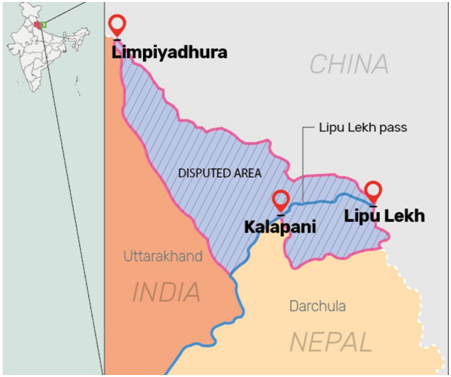
- Kalapani–Lipulekh–Limpiyadhura Dispute: Nepal has asserted its claim based on the Sugauli Treaty of 1816, signed between the East India Company and Guru Gajraj Mishra.
- Under the Treaty, the Kali River was marked as Nepal’s western boundary with India.
- Nepal claims the river originates at Limpiyadhura, which would place the Lipulekh and Kalapani regions within its territory. Conversely, India maintains that the river begins at a lower point near Kalapani, keeping the Lipulekh Pass, a strategic tri-junction between India, Nepal, and China, within its state of Uttarakhand.
- The Kali River has changed direction over the years, causing confusion in defining the border.
- Susta Border dispute: Susta is a disputed territory between Nepal and India. It is administered by India as part of West Champaran district of Bihar.
- Nepal claims the area a part of West Nawalparasi District under Susta rural municipality, alleging that over 14,860 hectares of Nepali land in Susta has been encroached upon by India.
Overview of India – Nepal Relations
- Shared Border: The country shares a border with five Indian states – Sikkim, West Bengal, Bihar, Uttar Pradesh and Uttarakhand.
- Land-locked Nepal relies heavily on India for the transportation of goods and services and access to the sea is through India.
- The India-Nepal Treaty of Peace and Friendship: Signed in 1950, it forms the bedrock of the special relations that exist between India and Nepal.
- Nepalese citizens avail facilities and opportunities on par with Indian citizens in accordance with the provisions of the Treaty.
- Defence Cooperation: India has been assisting the Nepal Army (NA) in its modernisation by supplying equipment and providing training.
- Both countries conduct Joint Military Exercise SURYA KIRAN alternately in India and in Nepal.
- Since 1950, India and Nepal have been awarding each other’s Army Chief with the honorary rank of General.
- The Gorkha regiments of the Indian Army are raised partly by recruitment from hill districts of Nepal.
- Trade and Economic: India remains Nepal’s largest trade partner and Investment where Indian firms account for 33.5 % of total FDI stock in Nepal.
- Nepal is India’s 17th largest export destination, up from 28th position in 2014.
- Main exports from India to Nepal are petroleum, iron & steel, automobiles, machinery, cereals, etc.
- Connectivity and Development Partnership: India is the largest developmental donor of Nepal in the field of priority sectors such as health, education and connectivity.
- Some of the major projects include Gauchar Airport (presently Tribhuvan Airport), East West Highway, development of cross-border rail links and establishment of Integrated Check Posts.
- Operation Maitri & post-earthquake reconstruction assistance: In the wake of the 2015 earthquake in Nepal, GoI was the first responder and carried out its largest disaster relief operation abroad (Operation Maitri).
- Cultural Ties: The leaders of the two countries have often noted the age-old ‘roti beti’ relationship, which refers to cross-border marriages between people of the two countries.
Other Areas of Concern
- Implementation Delays: Slow progress in certain connectivity and infrastructure projects has occasionally generated concerns in Nepal.
- Geopolitical Competition: China’s growing economic and strategic presence in Nepal has added a new dimension to regional geopolitics and India’s neighbourhood diplomacy.
- Perception of Asymmetry: Sections of Nepal’s political establishment and public discourse have at times expressed concerns over India’s dominant role in the bilateral relationship, often referred to as the “Big Brother” perception.
- Political Sensitivities: Domestic political developments and nationalist rhetoric in both countries can periodically create mistrust and strain bilateral ties.
- Water Resource Management: Differences over the management of shared rivers, hydropower cooperation, and flood-control projects continue to require close coordination and dialogue.
Way Forward
- Strengthen Diplomatic Dialogue: Resolve outstanding issues, including boundary disputes, through existing bilateral mechanisms and sustained diplomatic engagement.
- Enhance Connectivity and Trade: Accelerate the implementation of cross-border infrastructure, railway, road, and energy connectivity projects.
- Deepen Energy Cooperation: Expand collaboration in hydropower development, cross-border electricity trade, and transmission infrastructure.
- Promote Mutual Trust: Address concerns through regular high-level exchanges and respect for each other’s sovereignty and sensitivities.
- Expand People-to-People Ties: Strengthen educational, cultural, tourism, and youth exchanges to reinforce the age-old “Roti-Beti” relationship.
Source: TH
Previous article
PM Modi to Participate in 52nd G7 Summit in France
Next article
Mapping India’s Employment Landscape
